What Aging Face Analysis Really Reveals About Your Health
An aging face analysis is not just about vanity. The face is one of the most information-rich areas of the body, reflecting cumulative changes in skin structure, pigmentation, volume, and facial movement patterns over time. Many of the visible changes people notice first, such as fine lines around the eyes, uneven tone, or a loss of firmness, are also clues to broader biological processes.
From a scientific perspective, facial aging reflects a combination of intrinsic aging and extrinsic aging. Intrinsic aging is driven by genetics and the passage of time. Extrinsic aging is heavily shaped by environment and behavior, especially ultraviolet exposure, smoking, sleep disruption, stress, and nutrition. The skin is a living organ, and age-related changes in collagen, elastin, hydration, and pigment distribution can often be seen directly in the face.
Researchers studying skin aging and facial morphology have shown that visible age can correlate with health perception, inflammatory burden, and cumulative environmental exposure. While a face scan cannot diagnose disease, it can highlight patterns that are worth paying attention to.
- Wrinkle depth and distribution can reflect repeated muscle movement, collagen loss, and sun damage.
- Skin texture may reveal hydration status, barrier quality, and long-term photodamage.
- Pigmentation unevenness can point to UV exposure and inflammatory changes.
- Facial symmetry and contour may shift as soft tissue support changes with age.
In short, aging face analysis helps turn subjective impressions into measurable aging indicators. That makes it useful for tracking change, evaluating routine effectiveness, and understanding how your face aging signs compare over time.
How Face Age's AI Analysis Works
Face Age is designed to make facial aging assessment fast, consistent, and easy to understand. Instead of relying on a mirror or a rough guess, the platform uses computer vision to examine visible facial structure and skin-related features in a standardized way. The full process takes under 60 seconds.
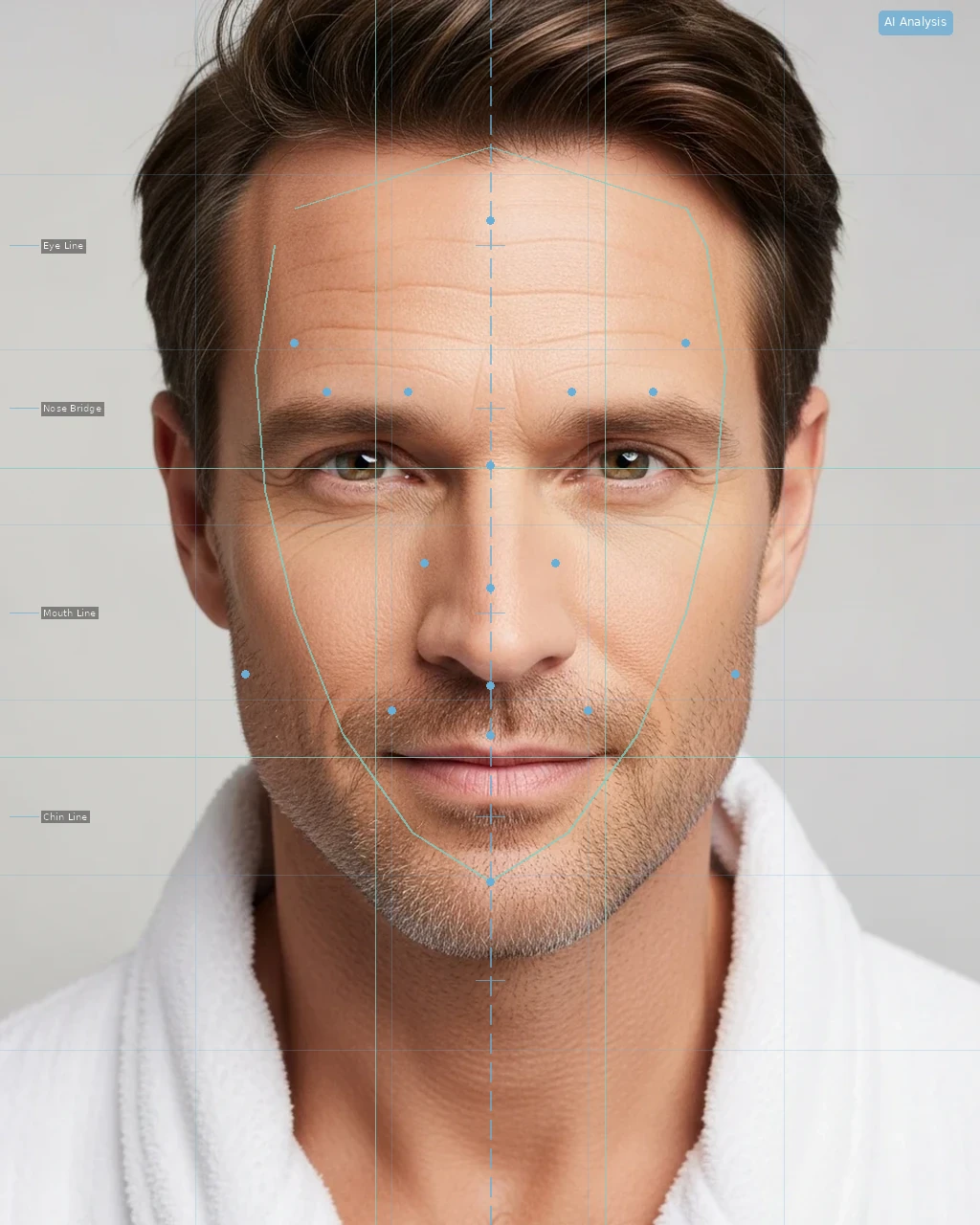
Image capture and landmark mapping. After you upload or take a clear facial photo, the system identifies 68 facial landmarks. These include key points around the eyes, nose, lips, jawline, brow, and facial outline. Landmark mapping helps measure facial proportions, asymmetry, and regional aging patterns.
Marker-level assessment. The algorithm then evaluates 12 age markers, including wrinkle presence, skin texture irregularity, tone evenness, visible firmness cues, and other face aging signs associated with biological age estimation. This stage also supports beauty and skin health scoring.
Result generation and interpretation. In seconds, Face Age returns a structured summary of your estimated biological age, symmetry-related outputs, skin health indicators, and an aging forecast. If you want an objective starting point for your skincare or wellness routine, this gives you one immediately. You can also revisit the tool over time to track change and compare results after lifestyle or product adjustments.
The value of this approach is consistency. The same framework is applied each time, making Face Age a practical way to monitor subtle shifts that are easy to miss day to day.
What You Will Discover
A good aging face analysis should do more than tell you that you look older or younger. It should show which specific features are influencing the result and how those patterns connect to visible skin health and facial structure. Face Age is built to provide that broader picture.
After analysis, you receive a set of outputs designed to translate complex visual data into useful insights. These metrics are especially helpful if you want to identify your strongest and weakest aging indicators, compare future scans, or understand whether your skincare and lifestyle habits are making a visible difference.
Estimated biological age: A model-based estimate of how your visible facial features align with age-related patterns.
Beauty score: A composite measure based on facial harmony, proportion, and visual balance.
Symmetry index: An assessment of left-right facial consistency, which can influence perceived attractiveness and age perception.
Skin health grade: A practical summary of clarity, evenness, hydration-related appearance, and visible UV-associated changes.
Wrinkle and texture insights: Region-specific cues that help explain where aging is most noticeable.
Aging forecast: A directional estimate of how current facial patterns may evolve if the same habits continue.
Progress tracking potential: A repeatable baseline you can use to monitor changes after sleep, nutrition, sunscreen use, or skincare adjustments.
For many users, the most valuable part is not the single score. It is the breakdown. Understanding which face aging signs are driving your result makes it easier to choose realistic next steps.
The Science Behind Aging Face Analysis
Aging face analysis sits at the intersection of dermatology, imaging science, and computer vision. Dermatologists have long assessed visible aging through features such as wrinkling, laxity, dyspigmentation, roughness, and vascular changes. What AI adds is speed, scale, and consistency in measuring those features from images.
One foundational concept is photoaging, the premature aging of skin caused largely by chronic ultraviolet exposure. The work of researchers such as Albert Kligman helped distinguish chronological aging from photoaging, showing that the two follow different visible patterns. Photoaged skin often shows coarse texture, irregular pigmentation, elastosis, and deeper wrinkling compared with skin aging driven mainly by time.
Structural skin changes also matter. The dermis gradually loses collagen density and elastic fiber organization with age, while repeated facial expressions etch dynamic lines into static wrinkles over time. These processes influence the visible markers an AI system can detect, including crow's feet, forehead lines, perioral changes, and skin surface irregularity. For background on the connective tissue involved, see collagen.
Computer vision research makes these observations measurable. Facial landmark detection allows software to map anatomical reference points and assess proportions, contour, and asymmetry in a repeatable way. Texture analysis methods can evaluate fine spatial patterns linked to roughness, pore visibility, and wrinkle density. Color analysis can quantify redness, dullness, and uneven pigmentation. Together, these methods support a more objective facial aging assessment than a casual visual impression.
Clinical literature also supports the use of standardized scales for visible aging. Studies on perceived age and skin quality suggest that age appearance is influenced by multiple interacting features rather than any single wrinkle or line. Reviews indexed on PubMed discuss how perceived age can function as a biologically meaningful marker, while additional dermatology literature on photoaging explains the mechanisms behind many common face aging signs.
That is why robust aging face analysis looks at several domains at once:
Shape and landmarks for facial proportions and support changes.
Texture features for fine lines, roughness, and microtopography.
Tone and pigmentation for unevenness and UV-related patterns.
Global pattern recognition for age estimation based on many small visible cues.
No consumer tool replaces a dermatologist, especially when you are concerned about a lesion, rash, or sudden change. But scientifically grounded image analysis can still provide a useful, defensible snapshot of how your face reflects cumulative aging influences.
Key Factors That Influence Your Aging Face Analysis
Your aging face analysis result is shaped by more than age alone. Two people of the same chronological age can score quite differently because visible aging reflects the combined effect of genetics, daily behavior, environment, and current skin condition.
Genetics sets the baseline for skin thickness, pigment tendency, facial structure, and how quickly collagen support changes over time. Some people are naturally less prone to wrinkling, while others show earlier expression lines or pigment irregularity.
Lifestyle can either slow or accelerate visible aging. Smoking is associated with oxidative stress and characteristic facial changes. Inadequate sleep may worsen dullness and under-eye appearance. Diet patterns low in protein, colorful plants, and healthy fats can also affect skin resilience indirectly.
Environment is a major driver. UV exposure remains one of the strongest external contributors to premature facial aging, and pollution may add oxidative burden. Even indoor habits matter if they reduce hydration or increase irritation.
Skincare routines influence the short- and long-term picture. Daily sunscreen, gentle cleansing, moisturization, and evidence-based actives can improve the visible features many analyses detect.
Sun exposure affects wrinkles, spots, and elasticity-related appearance.
Sleep quality influences puffiness, tone, and recovery.
Hydration affects plumpness and texture.
Routine consistency matters more than occasional intensive treatments.
If you want a practical baseline, run your analysis now and use it as a reference point. A facial aging assessment is most helpful when you compare results over time, not when you treat one scan as the final word.
Expert Tips to Improve Your Aging Face Analysis
You cannot stop aging, but you can improve many of the visible factors that influence an aging face analysis. The goal is not perfection. It is to support healthier skin function and reduce avoidable extrinsic damage.
Wear sunscreen every day. Broad-spectrum SPF is the most evidence-based way to reduce photoaging. Apply it consistently, not just on bright summer days. This is especially important if your analysis shows uneven tone, fine lines, or visible UV-related changes.
Prioritize sleep. Skin repair processes are closely linked to sleep quality. A stable sleep schedule may improve dullness, under-eye appearance, and overall recovery, especially when paired with good stress management.
Support the skin barrier. Use a gentle cleanser and a moisturizer that helps reduce water loss. Well-hydrated skin often looks smoother, calmer, and more even.
Eat and drink for skin health. Adequate protein supports structural maintenance, while fruits and vegetables provide antioxidants associated with healthier skin appearance. Hydration will not erase wrinkles, but dehydration can worsen the look of texture and fatigue.
Exercise regularly. Physical activity supports circulation, metabolic health, and stress regulation, all of which may influence how the skin looks over time.
Use proven actives carefully. Retinoids, vitamin C, niacinamide, and exfoliating acids can be useful for some concerns, but they should be introduced gradually to avoid irritation.
Use SPF daily.
Aim for consistent sleep and recovery.
Keep skincare simple and tolerable.
Track change instead of relying on memory.
For deeper evidence on skin aging and related biomarkers, explore Face Age research resources. Then repeat your analysis after several weeks to see whether your face aging signs are shifting in the direction you want.
AI Analysis vs Traditional Methods
Traditional facial aging assessment usually falls into one of three categories: self-evaluation in the mirror, manual grading by a clinician, or professional imaging in a clinic. Each has value, but each also has limitations.
Self-assessment is fast, but highly subjective. Lighting, mood, and familiarity with your own face can distort perception. Manual scoring by a dermatologist is more informed, yet it still depends on appointment access, human interpretation, and time. Clinical imaging systems can be detailed, but they are not always convenient or affordable for routine tracking.
AI-based aging face analysis offers a different advantage: instant standardization. Face Age applies the same landmark mapping and age-marker framework every time, producing results in under a minute. That makes it especially useful for repeat monitoring and comparing trends over time.
It is best seen as a complement, not a replacement, for medical care. For everyday tracking of face aging signs, however, an AI tool can be faster, more consistent, and more practical than traditional subjective methods.
Your Privacy and Data Security
Privacy matters when facial images are involved. Face Age is designed with a privacy-first approach so users can explore facial aging assessment without unnecessary data exposure.
Photos are processed in-browser, which means analysis happens locally on your device rather than being uploaded for long-term server storage. Images are not retained after the analysis session, are not sold, and are not shared with third parties for advertising or unrelated profiling.
The platform also follows a GDPR-conscious approach to data handling. In practical terms, that means minimizing data collection, limiting retention, and focusing on transparency. You can use the tool to understand your aging indicators without worrying that your face image becomes part of a hidden database.
Ready to Discover Your Aging Face Analysis?
If you want a clearer view of your face aging signs, a structured scan is more useful than guesswork. Aging face analysis can help you see how wrinkles, texture, symmetry, and skin health contribute to your visible age right now.
Face Age makes that process fast, private, and easy to repeat. You can get results in under 60 seconds, with no complicated setup and no need to interpret vague beauty claims. Try it as a baseline today, then come back after changes to your routine and see what actually moves your metrics.
You May Also Like
Biological Age Test: What Does Your Face Reveal? — Take a biological age test to see how your face reflects health, skin age, and...
How Old Do I Look Test: See What Your Face Reveals — Try a How Old Do I Look Test to estimate face age, skin aging and symmetry in...
Face Aging Simulator: See Your Future Face — Try a face aging simulator to preview future changes, compare age markers, and...