What Jawline Analysis Really Reveals About Your Health
A jawline analysis is often seen as a beauty check, but it can reveal more than simple attractiveness. The contour of the lower face is influenced by bone structure, soft tissue distribution, skin firmness, and muscle tone. When these factors change, the jawline can appear sharper, softer, more asymmetric, or less defined over time.
From a health perspective, jawline definition may reflect broader patterns in body composition and aging. Increased submental fullness, for example, can be associated with higher facial adiposity, while skin laxity can point to collagen loss and reduced tissue support. The lower face is also one area where age-related changes become visible relatively early because support structures shift gradually across adulthood.
The bony foundation matters too. The mandible, or lower jaw bone, strongly shapes profile and front-facing balance. Its dimensions influence chin projection, lower-face width, and the transition from ear to chin. You can learn more about the anatomy of the mandible on Wikipedia.
- Jaw angle and contour can affect facial harmony and profile balance.
- Soft tissue fullness may alter how sharp or diffuse the jaw appears.
- Skin elasticity influences whether the lower face looks tight or lax.
- Asymmetry can reflect natural variation, dental factors, posture, or image angle.
That does not mean a jawline analysis is a medical diagnosis. It is best understood as a structured visual assessment of facial morphology and age-related cues. Used properly, it can help you track changes, understand your facial proportions, and make more informed decisions about skincare, weight management, grooming, or professional consultation.
How Face Age's AI Analysis Works
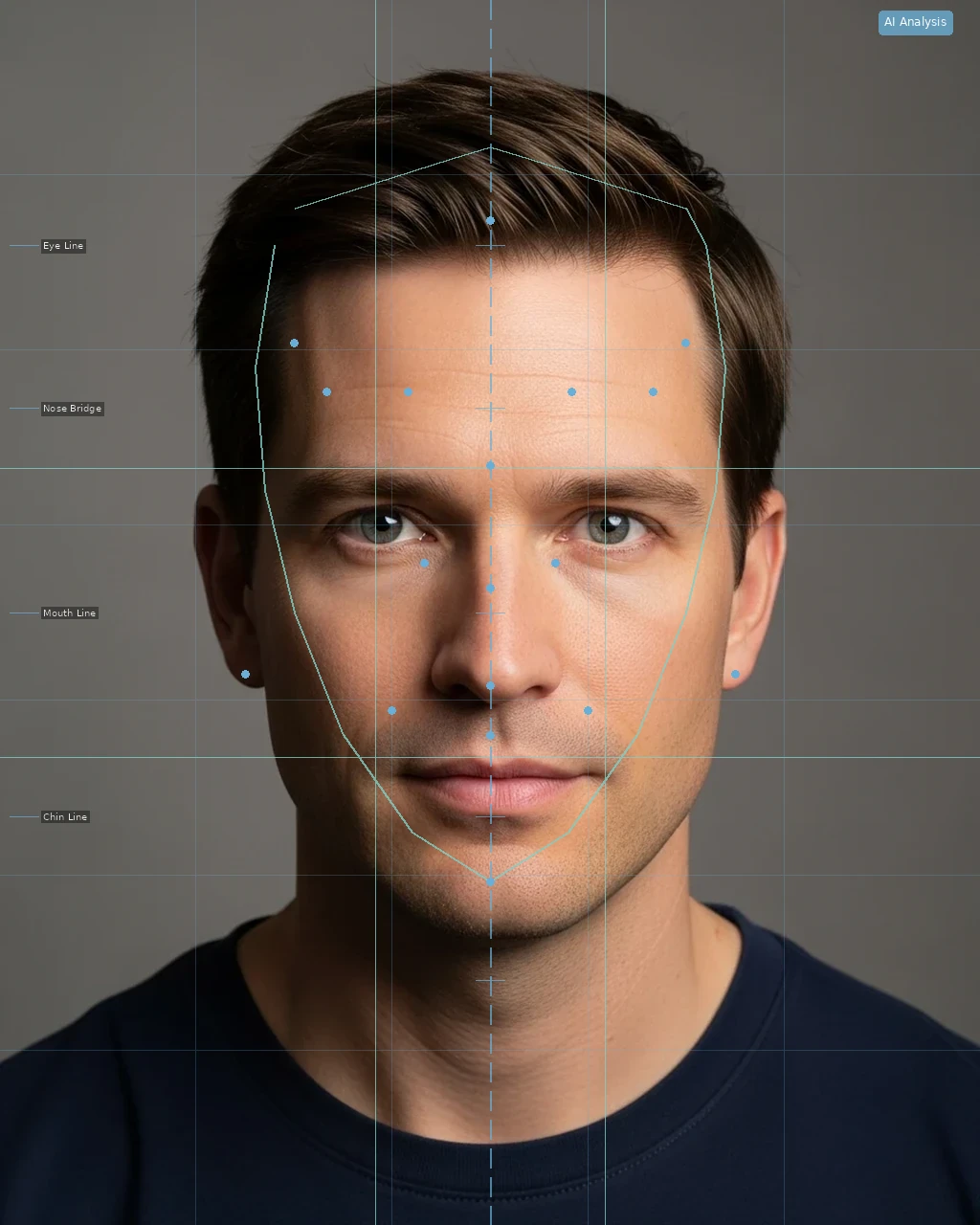
Face Age is designed to make jawline analysis fast, measurable, and easy to repeat. Rather than producing a vague opinion, the system evaluates facial geometry and visible aging cues from a photo using landmark-based computer vision. The process typically takes under 60 seconds.
Image capture and landmark mapping. After you upload a clear front-facing photo, the system detects 68 facial landmarks across the eyes, nose, mouth, chin, cheeks, and jaw border. These points help measure lower-face width, chin position, mandibular contour, and left-right balance.
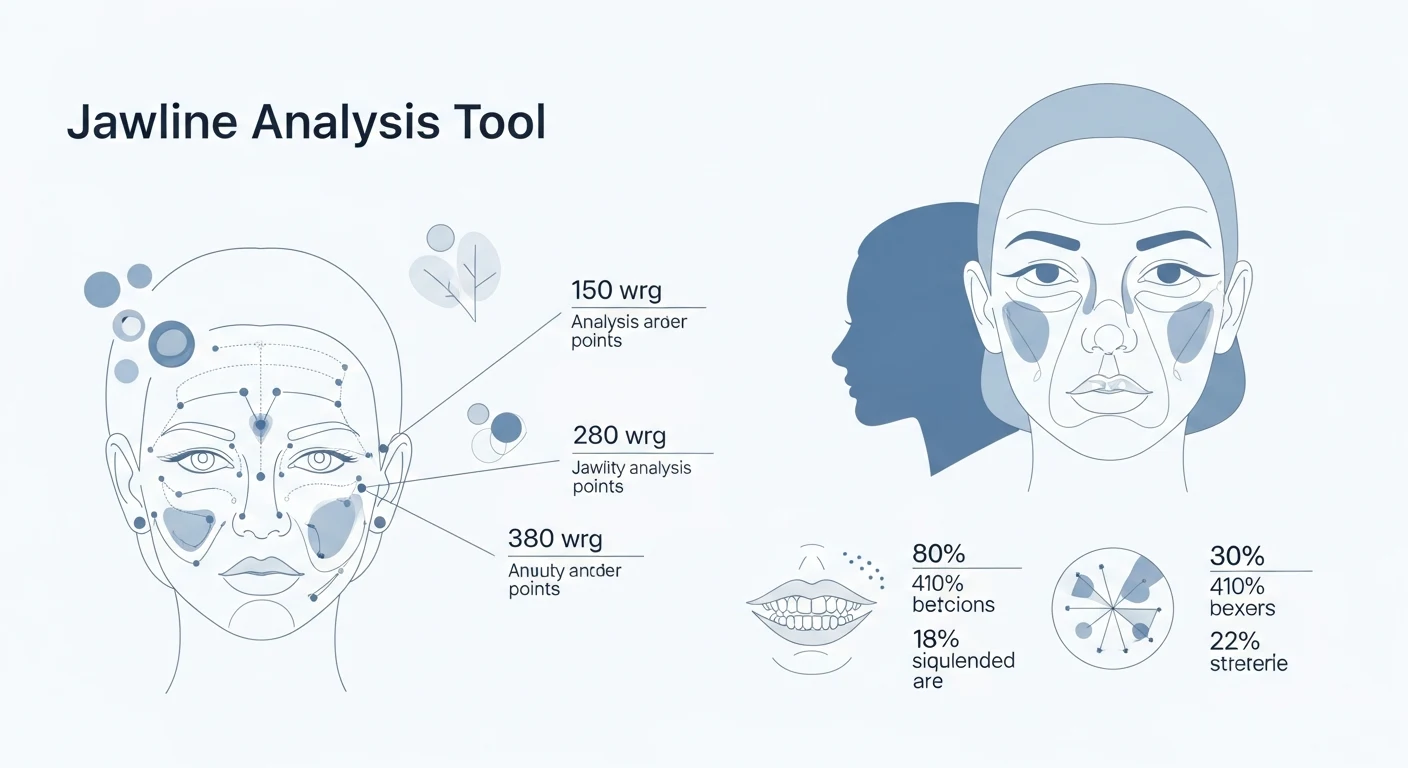
Age and beauty feature extraction. The platform then evaluates 12 age markers, including wrinkle patterns, texture, elasticity indicators, and skin evenness. At the same time, it calculates beauty-related measurements such as proportion, symmetry, and jawline continuity. This provides a more useful output than a basic jawline rating alone.
Instant reporting. You receive a structured summary showing your jaw shape analyzer results alongside broader face metrics like biological age, symmetry index, and skin health indicators. If you want to monitor changes over time, repeating the analysis under similar lighting can help you compare trends more reliably. For readers interested in methodology, Face Age also shares more scientific context at https://face-age.net/research.
The value of this approach is consistency. Instead of relying on memory, selfies taken from different angles, or subjective comments, you get a repeatable baseline that helps you understand your lower-face structure with more precision.
What You Will Discover
A good jaw shape analyzer should not stop at a single number. The appearance of the jawline depends on structure, skin, age, and facial harmony working together. Face Age therefore provides a broader readout that helps place your jawline result in context.
After analysis, you can expect insights across several dimensions of facial appearance and aging. This makes the result more practical whether your goal is beauty tracking, self-assessment, or monitoring visible change over time.
Biological age estimate. An AI-based assessment of visible age markers from skin texture, elasticity cues, and wrinkle distribution.
Beauty score. A composite measure informed by proportion, balance, and facial harmony rather than a purely subjective attractiveness label.
Symmetry index. A comparison of left and right facial correspondence, including lower-face balance that can influence how defined the jaw appears.
Jawline rating. A focused evaluation of lower-face definition, contour continuity, chin-to-jaw transitions, and apparent sharpness.
Jaw shape classification. A structured description of overall lower-face form, which may include broader, tapered, rounded, or angular patterns.
Mandible analysis metrics. Measurements related to chin projection, lower-face width, and the relationship between jaw angles and facial proportions.
Skin health grade. Indicators tied to clarity, evenness, hydration-related appearance, and visible photodamage that can soften or obscure the jaw border.
Aging forecast. An estimate of where future visible change may emerge first, such as laxity near the lower cheeks, neck transition, or marionette area.
Taken together, these outputs help answer a more useful question than “Do I have a good jawline?” They help you understand why your jawline looks the way it does and which factors may be changing it.
The Science Behind Jawline Analysis
Jawline analysis sits at the intersection of anatomy, dermatology, aging science, and computer vision. At the anatomical level, lower-face appearance depends on the shape of the mandible, the size and position of the chin, and the distribution of overlying tissues. Researchers in craniofacial science have long studied facial proportions and symmetry because humans are highly sensitive to these features during face perception.
In aesthetics research, symmetry and averageness were famously discussed by researchers including David Perrett, while lower-face shape has also been examined in relation to sexual dimorphism and age perception. These studies do not suggest there is one ideal jawline for everyone. Rather, they show that humans tend to notice regularity, balance, and contour continuity quickly.
Dermatology adds another layer. As skin ages, collagen and elastin networks change, reducing firmness and recoil. This can soften the jaw border even when bone structure remains the same. Photoaging from ultraviolet exposure also affects texture and tissue support. For background on the skin aging process, see this Wikipedia article on skin aging and the classic review by Fisher and colleagues on collagen loss and photoaging mechanisms at PubMed.
Computer vision makes it possible to quantify these visible features from photographs. Landmark detection algorithms identify stable reference points around the face, then calculate distances, angles, ratios, and asymmetry. In a jawline context, this includes the mandibular border, gonial region, chin contour, and lower-face width. These measurements become more meaningful when combined with skin-level markers such as shadows, texture variation, and signs of tissue descent.
There is also a connection to body composition. Facial adiposity research suggests that weight distribution can influence perceived health and age. Even modest changes in weight or hydration can alter the lower-face outline in photos. A landmark-based jaw shape analyzer therefore works best when interpreted as a visual metric, not as a fixed statement about identity.
In practical terms, the science supports three defensible ideas. First, jawline appearance is measurable. Second, it changes with age, environment, and lifestyle. Third, repeatable image analysis can help track those changes more objectively than memory or casual observation alone.
Key Factors That Influence Your Jawline Rating
Your jawline rating is shaped by both fixed and modifiable factors. Some people naturally have a more angular mandible or stronger chin projection due to genetics. Others may have a softer lower face despite excellent skin and low body fat simply because their skeletal proportions differ.
Lifestyle plays a large role too. Weight gain can increase facial fullness around the jaw and under the chin, while poor sleep and dehydration may temporarily worsen puffiness. Chronic sun exposure can accelerate skin aging, reducing firmness along the lower cheeks and blurring the jaw border. Posture also matters more than many people realize. Forward-head posture can change neck tension and alter how the jaw and chin appear in both photos and real life.
- Genetics: bone structure, chin projection, facial width, and natural asymmetry.
- Body composition: facial fat distribution and submental fullness.
- Skin quality: collagen integrity, elasticity, and texture.
- Environment: UV exposure, smoking, and pollution-related oxidative stress.
- Daily habits: sleep, hydration, diet quality, and activity level.
- Photo conditions: lighting, camera angle, facial expression, and head position.
This is why it is useful to test your jawline with a consistent setup and not overinterpret a single image. If you want a baseline, try Face Age with neutral expression, even lighting, and a front-facing pose. That gives your mandible analysis the best chance of reflecting structure rather than temporary visual noise.
Expert Tips to Improve Your Jawline Rating
Improving your jawline rating usually means improving the factors that influence lower-face definition rather than chasing unrealistic perfection. In many cases, the biggest gains come from supporting skin quality, reducing avoidable puffiness, and maintaining healthy body composition.
Protect collagen with daily sunscreen. UV exposure is one of the most evidence-backed drivers of visible skin aging. A broad-spectrum sunscreen can help preserve firmness and reduce the gradual softening that makes the jawline look less distinct.
Prioritize sleep. Poor sleep is linked to duller skin, more swelling, and a more fatigued appearance. Aim for consistency, not just occasional recovery sleep.
Stay hydrated and moderate excess sodium. Hydration supports skin appearance, while very salty meals can contribute to temporary facial puffiness in some people.
Support skin with nutrition. Diets rich in protein, fruits, vegetables, and omega-3 fats can help support tissue maintenance and overall skin health.
Exercise regularly. General fitness and weight management can influence submental fullness and facial adiposity over time.
Use posture and photo technique wisely. Neutral head position, relaxed shoulders, and natural lighting often produce a more accurate representation of your real jawline.
Topical skincare may also help, especially when focused on photoprotection, barrier support, and ingredients with evidence for improving skin texture and firmness. You can explore more evidence-based reading through Face Age research resources.
Most importantly, track progress realistically. Bone structure will not change from skincare alone, but visible definition can improve when skin quality, weight stability, and inflammation are better managed. Repeating a jaw shape analyzer every few weeks under similar conditions can help you see gradual change more clearly.
AI Analysis vs Traditional Methods
Traditional jawline assessment usually falls into three categories: subjective opinion, manual photography comparison, or in-person expert evaluation. Each can be useful, but each also has limitations. Friends or social media comments are highly subjective. Mirror checks depend on lighting and angle. Even professional assessment can vary between observers unless specific measurements are used.
AI analysis offers a different advantage: speed and consistency. Face Age applies the same landmark detection logic each time, making it easier to compare your results across sessions. Instead of relying only on visual impression, it measures facial geometry, symmetry, and skin-linked age cues in one report.
That does not replace a dermatologist, dentist, or surgeon when clinical concerns are involved. But for everyday tracking, a digital jawline rating is far more scalable than repeated appointments. It is also faster than manual scoring and less vulnerable to mood, memory, or bias than casual self-assessment.
Your Privacy and Data Security
Facial analysis only works when users trust the process. Face Age is built with a privacy-first approach designed to minimize risk and maximize control. Photos are processed in-browser, which means analysis happens locally on your device rather than being stored for later use on remote servers.
Your image is never shared with third parties for advertising or resale. After analysis, photos are deleted immediately rather than kept in a long-term image database. This helps reduce unnecessary exposure of sensitive biometric information.
The platform is also designed around GDPR-compliant principles, including data minimization and clear purpose limitation. For users who want a jaw shape analyzer without sacrificing privacy, that difference matters.
Ready to Discover Your Jawline Rating?
Your jawline reflects more than a single beauty trend. It combines bone structure, symmetry, skin quality, and age-related change into one of the most noticeable features of the face. A structured analysis can help you understand that picture more clearly.
With Face Age, you can get a fast jawline rating, broader mandible analysis, and supporting metrics like symmetry and biological age in under a minute. There is no complicated setup, no need for expert knowledge, and no signup barrier for getting started. If you want an instant, objective look at your lower-face structure, try the Jawline Analysis Tool now.
You May Also Like
Beauty Score Test: What Your Face Reveals — Take a beauty score test to see your facial beauty score, symmetry and skin...
Celebrity Look Alike Test: Find Your Famous Match — Take a celebrity look alike test to find your face match, beauty insights, and...
Attractiveness Scale Calculator: What Your Score Means — Use our attractiveness scale calculator to rate attractiveness, compare 1-10...