What Anti Aging Score Calculator Really Reveals About Your Health
An anti-aging score is not a diagnosis, and it is not a crystal ball. What it can do is quantify visible features that often track with biological aging, skin resilience, and overall lifestyle exposure. When an image-based system evaluates wrinkles, texture irregularity, facial contour changes, pigmentation patterns, and symmetry, it is measuring signals that can reflect cumulative stress on the skin and soft tissue.
Your face is one of the most information-rich surfaces on the body. Skin thinning, loss of elasticity, uneven tone, and structural changes around the eyes and mouth are influenced by collagen breakdown, hydration status, sun exposure, sleep quality, and smoking history. These are not random cosmetic details. They are biological outputs that often overlap with aging pathways studied in skin aging research.
A useful anti-aging assessment helps you move from guesswork to observation. Instead of asking, “Do I look tired?” you can ask more specific questions:
- Does my skin texture suggest reduced elasticity?
- Are pigment changes making my face look older than my actual age?
- Is facial asymmetry increasing because of expression patterns or volume loss?
- How does my visible age compare with my chronological age?
That is why many people also think of this as a reverse aging score or age reversal index. The number itself matters less than the trend. If your score improves over time, it may indicate better skin care consistency, healthier daily habits, or reduced photoaging pressure. The real value is not vanity. It is getting a clearer, measurable snapshot of how your face is responding to your environment and routine.
How Face Age's AI Analysis Works
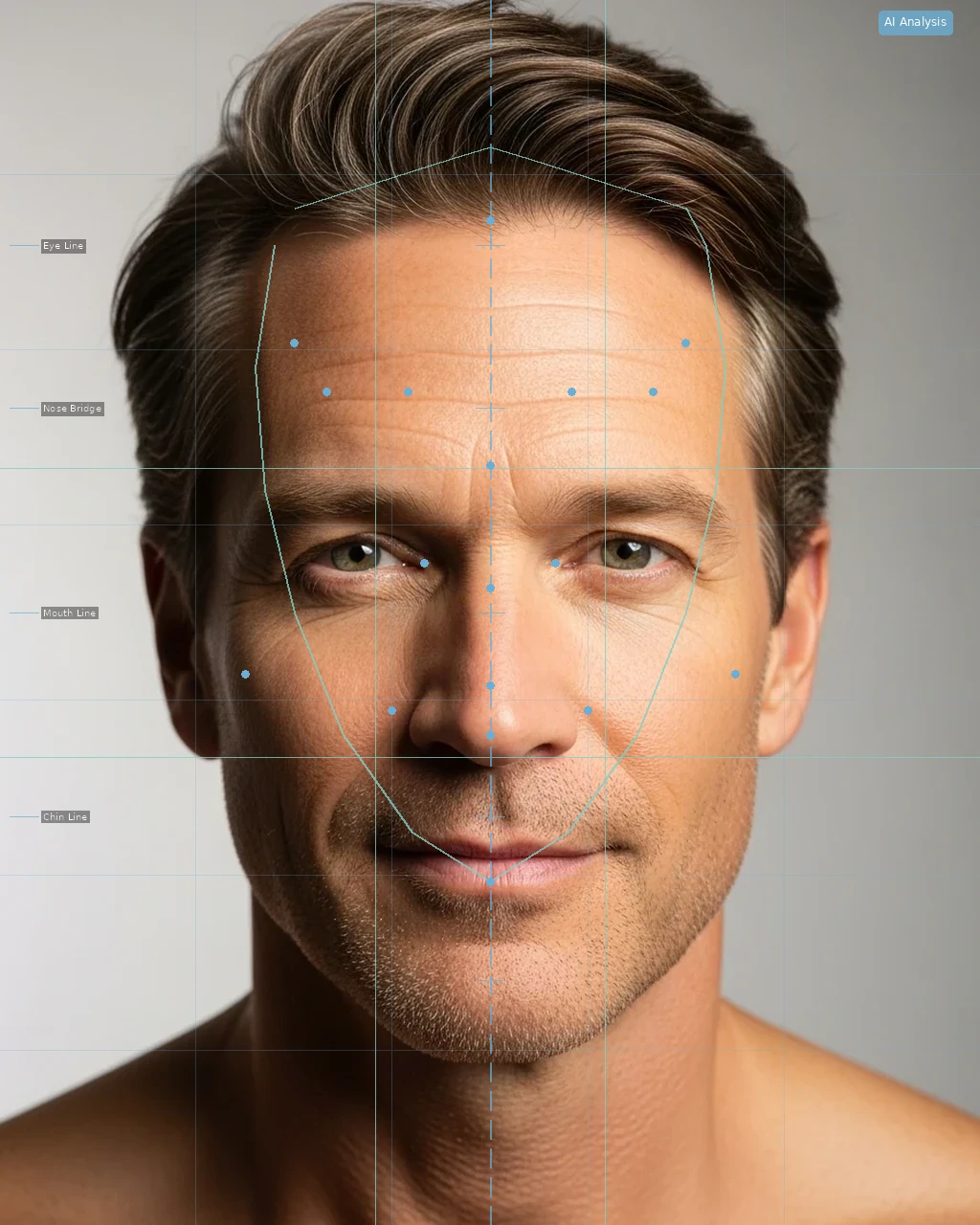
Face Age is designed to make anti-aging assessment fast, consistent, and easy to repeat. The system analyses 68 facial landmarks and evaluates 12 age markers including wrinkle distribution, texture variation, perceived firmness cues, facial proportions, and visible skin evenness. The full analysis is completed in under 60 seconds, so you can get a baseline without booking an appointment or learning a scoring system.
Image capture and quality check. You upload or capture a clear, front-facing photo in good lighting. The system checks alignment, face visibility, and image usability so the analysis is based on interpretable features rather than shadows or blur.
Landmark mapping and marker extraction. The AI maps 68 key facial landmarks around the eyes, nose, lips, jawline, forehead, and cheek contours. It then measures 12 visible age-related markers, including texture roughness, wrinkle-prone regions, skin clarity, and symmetry patterns.
Score generation and interpretation. Face Age converts those observations into outputs such as biological age estimate, beauty metrics, and skin-health indicators. If you want a fast starting point for your anti-aging score calculator, this gives you an actionable baseline you can return to after routine changes.
The goal is not to replace clinical care. It is to give you a repeatable, structured way to track visible aging signals. If you are curious how your current habits are showing up on your face, trying the analysis is the quickest way to see where you stand.
What You Will Discover
A strong anti-aging assessment should give you more than a single number. Face Age is designed to provide multiple outputs so you can understand not just whether your visible age appears higher or lower, but why. That is what makes an anti-aging score more useful than a generic beauty filter or age guesser.
After analysis, you can review a set of measurements that connect appearance with aging-related indicators:
- Biological age estimate: a facial-age reading based on visible markers rather than date of birth alone.
- Anti-aging score: a composite score that reflects how favorable your visible aging profile appears at the time of analysis.
- Beauty score: a structured readout based on proportions, balance, and overall facial harmony.
- Symmetry index: a comparison of left-right facial balance across key landmarks.
- Skin health grade: an overview of visible clarity, evenness, hydration cues, and texture quality.
- Aging forecast: a directional estimate of which visible markers may matter most if your current habits continue.
- Feature-level insights: areas such as eye region lines, nasolabial changes, pigmentation patterns, or surface roughness that may be contributing to your result.
This matters because two people with the same chronological age can have very different visible aging profiles. One may score lower due to UV-related pigmentation and dehydration, while another may be affected more by expression lines or volume changes. Looking at multiple outputs gives context to your reverse aging score and makes it easier to identify realistic next steps.
If your goal is prevention, maintenance, or improvement, the most useful result is not the number alone. It is the pattern behind the number.
The Science Behind Anti Aging Score Calculator
An anti-aging score calculator sits at the intersection of dermatology, facial anthropology, and computer vision. The science is not based on a single universal biomarker. Instead, it combines multiple visible traits that have known relationships with aging, especially in the skin and periorbital region. Researchers have long shown that age perception is influenced by wrinkle depth, dyspigmentation, skin smoothness, contrast, and facial sagging patterns.
One of the most important concepts is photoaging, the cumulative skin damage caused by ultraviolet exposure. Dermatologist Albert Kligman helped popularize this distinction between intrinsic aging and environmentally accelerated aging. Photoaged skin often shows coarse texture, mottled pigmentation, laxity, and fine lines beyond what would be expected from time alone. You can review the broader concept here: photoaging.
Computer vision systems translate these visible patterns into quantifiable features. Landmark detection identifies stable anatomical reference points. Texture analysis examines local contrast and micro-roughness. Shape analysis evaluates contours, proportional relationships, and asymmetry. Together, these methods make facial assessment more reproducible than unaided visual judgment.
There is also strong evidence that skin quality affects perceived age. Studies indexed on PubMed have linked uneven pigmentation and wrinkling with older age appearance and have shown that perceived age can function as a biologically meaningful signal in population research. For background, see this PubMed article on perceived age as a biomarker of aging. Research on facial skin topography and age perception has likewise shown that surface detail and color distribution strongly influence how old a face looks: PubMed reference.
That does not mean every score is absolute. Lighting, facial expression, makeup, and camera quality can all shift the appearance of age markers. Good systems account for this with quality checks and standardised landmark analysis, but no image-based tool should claim clinical certainty from one photo.
The most defensible use of an anti-aging assessment is trend tracking. If you analyse under similar conditions across weeks or months, changes in your age reversal index may reflect whether your skin barrier, sun protection, sleep routine, or overall recovery habits are improving visible outcomes. In that sense, the score becomes a practical monitoring tool grounded in measurable appearance science.
Key Factors That Influence Your Anti-Aging Score
Your anti-aging score is shaped by a mix of biology and behavior. Some influences are difficult to change, such as bone structure, baseline skin type, and genetic tendencies in collagen breakdown or pigmentation. Others are highly modifiable and often explain why a person’s visible age can improve or worsen over time.
The major factors include:
- Genetics: inherited skin thickness, facial structure, melanin response, and wrinkle tendency all affect visible aging patterns.
- Sun exposure: repeated UV exposure accelerates pigment changes, collagen damage, and uneven texture.
- Sleep quality: poor sleep can worsen under-eye appearance, dullness, and recovery capacity.
- Smoking and pollution: oxidative stress and reduced circulation can contribute to earlier lines and roughness.
- Hydration and barrier function: dry or irritated skin often looks older because fine lines and texture become more visible.
- Nutrition and exercise: metabolic health, inflammation control, and blood flow influence skin appearance over time.
- Skincare consistency: sunscreen, retinoids, moisturisers, and pigment-management strategies can meaningfully affect visible aging.
Even facial expression habits can matter. Repeated movement patterns around the forehead, eyes, and mouth may deepen dynamic lines over the years. That does not mean you should stop smiling. It means visible aging is cumulative and multifactorial.
If you want to understand your current baseline instead of guessing, an AI-based anti-aging assessment can help identify which visible factors are most likely influencing your score today. From there, you can focus your effort where it is most likely to count.
Expert Tips to Improve Your Anti-Aging Score
The best way to improve an anti-aging score is not to chase miracles. It is to reduce the daily inputs that speed visible aging and strengthen the habits that support skin repair. Small changes done consistently usually matter more than expensive products used irregularly.
- Use sunscreen every day. Broad-spectrum SPF is still the most evidence-based tool for limiting photoaging. Apply enough, and reapply when you are outdoors.
- Prioritise sleep. Recovery affects facial puffiness, tone, and overall skin resilience. Aim for stable sleep timing rather than occasional catch-up nights.
- Support hydration. Drink enough fluids, but also protect the skin barrier with a suitable moisturiser to reduce dryness-related texture.
- Eat for skin health. A diet rich in protein, colorful plants, and healthy fats supports repair processes and helps manage inflammation.
- Exercise regularly. Physical activity supports circulation, metabolic health, and stress regulation, all of which influence visible aging over time.
- Consider evidence-based skincare. Ingredients such as retinoids, niacinamide, and antioxidants may help improve texture, tone, and fine-line appearance when used appropriately.
- Track progress, not perfection. Repeating your anti-aging assessment under similar lighting and expression conditions is often more informative than checking constantly in the mirror.
If you want to understand the research behind facial aging and image-based analysis, explore Face Age research resources. You can also use the calculator as a baseline tool, then reassess after a few weeks of consistent sun protection or skincare changes.
Think of your age reversal index as feedback, not judgment. Improvement is usually gradual, but visible trends can be meaningful when your routine is evidence-based and repeatable.
AI Analysis vs Traditional Methods
Traditional aging assessment usually falls into one of three categories: self-judgment in the mirror, aesthetic consultation, or manual grading scales used by clinicians and researchers. Each can be useful, but each has limits. Self-assessment is subjective. Clinical evaluation is valuable but takes time and cost. Manual scales are structured, yet they still depend on human interpretation.
AI analysis offers a different advantage: speed, consistency, and repeatability. Instead of relying on memory or mood, it measures the same categories each time from the same kind of image input. Face Age can return results in under a minute, making it practical for regular check-ins rather than occasional appointments.
That does not make AI better than a dermatologist for medical concerns. It makes it better for fast, standardised tracking of visible age markers. For someone searching for an anti-aging score calculator, the main benefit is friction-free measurement. You can see your baseline, monitor changes, and decide whether your current routine is moving your visible aging profile in the right direction.
Your Privacy and Data Security
Privacy matters when the input is your face. Face Age is designed with a privacy-first approach so users can run an anti-aging assessment without wondering where their image will end up. Photos are processed in-browser whenever supported, which means analysis happens locally on your device rather than being stored on a remote server for later use.
Images are not stored after analysis, are deleted immediately from active processing, and are not shared with third parties. The platform is built to align with GDPR-compliant principles around data minimisation and user control. In practical terms, that means you can check your anti-aging score without creating a permanent photo trail.
Ready to Discover Your Anti-Aging Score?
If you want a clearer picture of how your skin, facial structure, and visible age markers are working together, an anti-aging score can give you a useful starting point. In less than a minute, you can see a biological age estimate, skin-health signals, symmetry insights, and a more informed reverse aging score.
There is no complicated setup and no need to guess what the mirror is telling you. Try Face Age to get a fast, private, no-signup baseline and see where your current aging profile stands today.
You May Also Like
Epigenetic Age Test: What Your Body Clock Shows — Take an epigenetic age test and understand your biological aging signals. Learn...
Biological Age Test: What Does Your Face Reveal? — Take a biological age test to see how your face reflects health, skin age, and...
How Old Do I Look Test: See What Your Face Reveals — Try a How Old Do I Look Test to estimate face age, skin aging and symmetry in...